


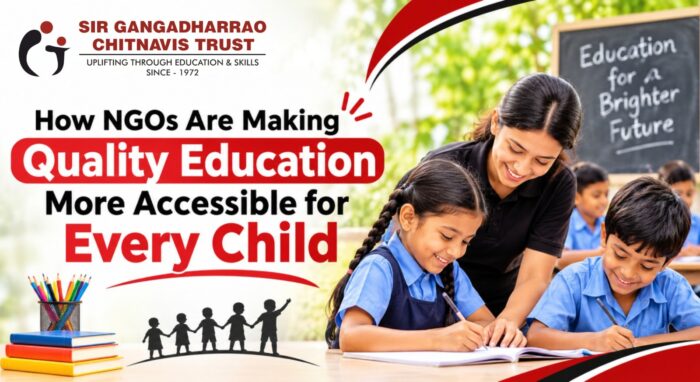
How NGOs Are Making Quality Education More Accessible for Every Child
Think about a child in a small village who walks three kilometres every morning just to reach a school with one teacher and no benches. Now think about another child in a city slum who has the brains to become an engineer but has to sell vegetables after class to help the family eat. Both have talent. What they lack is opportunity.
This is the gap that NGOs working in education have been trying to close for decades. While governments run the big schemes, it is often non-profit organisations that reach the last mile, the child who slips through every crack in the system. Let’s look at how they are making quality education accessible for every child.
Why Access to Quality Education Is Still a Problem
India and many other countries have made real progress in enrolment. But getting a child into school is only half the battle. Many children still drop out because of poverty, child labour, early marriage, long distances or poor teaching. Even those who stay often cannot read or do basic maths at their grade level.
So when we talk about quality education, we mean more than a classroom. We mean trained teachers, safe buildings, books, meals, and a learning environment where a child actually wants to come back tomorrow.
- Bringing Schools to Where Children Live
Many NGOs set up learning centres right inside villages, slums and tribal areas. Instead of waiting for families to send children far away, they bring the classroom to the doorstep. Some run bridge schools for children who never enrolled or dropped out, helping them catch up so they can join mainstream schools.
This approach works because it removes the biggest barrier first: distance and fear. Parents are far more comfortable when the school is next to their home.
- Scholarships and Financial Support
For a lot of families, the problem is not that they don’t value education. They simply can’t afford uniforms, books, fees and transport. NGOs step in with scholarships, free stationery, school kits and sometimes even monthly support so that a child is not pulled out of school to earn.
A small amount of help at the right moment can change the direction of a child’s whole life. That is why scholarship programmes for underprivileged children are among the most effective things education NGOs do.
- Focus on Girl Child Education
In many communities, girls are the first to be told to stay home. NGOs work hard to change this, not just by paying for school but by talking to parents, running awareness drives and creating safe spaces for girls to learn. Some provide bicycles, sanitary products and counselling.
When a girl finishes school, the effect goes beyond her. She earns better, marries later, raises healthier children and sends them to school too. Girl child education is one of the strongest ways to break the cycle of poverty.
- Training Teachers, Not Just Opening Schools
A building does not teach. Teachers do. Many NGOs now invest in teacher training, helping teachers use activity-based methods, local languages and simple tools that make lessons interesting. When a teacher knows how to explain fractions using bangles or mangoes, children actually understand.
Better teaching means children learn more in the same number of hours, which is the real meaning of quality.
- Using Technology to Reach Remote Areas
Digital learning has opened new doors for rural education. NGOs are distributing tablets, setting up computer labs, running offline learning apps and conducting classes over mobile phones where internet is weak. During the pandemic, many of these efforts kept thousands of children connected to their studies when schools were shut.
Technology will never replace a good teacher, but it can fill gaps where teachers are scarce.
- Mid-Day Meals, Health and Life Skills
A hungry child cannot concentrate. Many NGOs provide nutritious meals, health check-ups and clean drinking water along with education. Others add life skills, computer basics, art, sports and career guidance so that children grow as whole people, not just exam-takers.
- Involving Parents and Communities
The most lasting change happens when the community owns the school. NGOs hold parent meetings, form village education committees and encourage local volunteers to help. When parents understand why education matters, children are far less likely to drop out.
What the Results Look Like
You can see the impact in small ways: a child reading a full sentence for the first time, a girl clearing Class 10 when nobody in her family ever did, a boy from a labouring family getting into college. These stories repeat in thousands of homes because of steady, patient work by NGOs and their volunteers.
How You Can Help
You don’t need to run an organisation to make a difference. You can:
- Donate to a trusted education NGO, even a small monthly amount
- Volunteer your time to teach, mentor or help with digital classes
- Sponsor a child’s education for a year
- Spread awareness by sharing the work of NGOs on social media
- Donate books, laptops or stationery that you no longer use
Always check an NGO’s registration, annual reports and transparency before donating.
Final Thoughts
Every child deserves a fair chance to learn, no matter where they are born or how much their family earns. NGOs are proving that this is possible, one village, one classroom and one child at a time. But they cannot do it alone. When individuals, communities and governments walk together, education for every child stops being a dream and becomes a promise we actually keep.